

How does dry cleaning work? Your clothes are cleaned in specialized equipment using a professional cleaning solvent rather than water as the primary cleaning medium. However, the machine cycle is only one part of the process.
A typical professional workflow also includes garment identification, care-label inspection, stain treatment, solvent recovery, finishing and a final quality check. Exact methods vary by cleaner, garment and care instructions.

Quick Answer: How Does Dry Cleaning Work?
Dry cleaning removes soil from suitable garments in a commercial machine using a cleaning solvent instead of a standard water-and-detergent wash. Before cleaning, garments are inspected and stains may be pretreated.
After the machine cycle, solvent is recovered, the garment is checked again, then pressed or otherwise finished before return.
The Dry Cleaning and Laundry Institute describes professional dry cleaning as a broader production chain that begins with intake and examination and ends with finishing, inspection and packaging.
Why Is It Called Dry Cleaning If Liquid Is Used?
The name is slightly misleading. Dry cleaning is not literally dry.
The key difference is that water is not the primary cleaning medium. The FTC defines dry cleaning as a commercial process that removes soil in a machine using a common organic solvent.
Under the FTC Care Labeling Rule, the process can also include controlled moisture, tumble drying and steam pressing or steam-air finishing. So the useful distinction is solvent-based professional cleaning versus conventional water-based washing.
The Dry Cleaning Process: 7 Typical Steps
Not every cleaner uses the exact same equipment or workflow. Still, professional industry guidance follows a consistent sequence from intake through final finishing.
1. Intake, Tagging and Garment Inspection
The process starts before anything enters a machine. Garments are identified so they stay associated with the correct order, then inspected for visible condition, care instructions and areas that may need attention.
This is also when a cleaner can note loose buttons, trim, existing damage or construction details that may affect handling.
2. Care Labels and Stains Are Assessed
Next, the garment’s care label and visible stains help guide the cleaning approach.
The FTC requires manufacturers covered by its Care Labeling Rule to have a reasonable basis for dry-cleaning instructions and warnings. A label may also restrict solvent type, moisture, heat or finishing methods.
If you want the deeper label explanation, read Breeze Laundry’s Dry Clean Only guide.
3. Stains May Be Pretreated
Some stains need attention before the main cleaning cycle. A professional cleaner can choose treatment based on the stain, fabric and garment construction.
This matters because oily soil, water-based stains, dyes and delicate finishes do not all respond to the same chemistry. No responsible process can guarantee that every stain will disappear, especially if the stain has aged, changed the dye or damaged the fiber.
4. The Garment Is Cleaned in Solvent
The garment is placed in specialized dry-cleaning equipment, where solvent circulates through the load while the machine provides controlled mechanical action.
The Dry Cleaning and Laundry Institute notes that solvent is especially effective at dissolving greases and oils. Meanwhile, industry guidance from the National Cleaners Association describes filtration as part of the machine cycle so loosened soil and particles can be removed from the circulating solvent.
5. Solvent Is Extracted, Recovered and the Garment Is Dried
After the cleaning portion of the cycle, the machine removes solvent from the garments rather than sending it down a drain like wash water.
Modern professional systems can recover solvent during extraction and drying so it can be reused within the equipment. The National Cleaners Association describes extraction, reclamation and controlled cool-down as distinct parts of the machine cycle.
6. The Garment Is Inspected Again
Cleaning is not automatically finished when the machine stops.
The garment is checked for remaining stains, condition and overall appearance. If an area still needs attention, additional stain treatment or reprocessing may be considered when appropriate for the item.
7. Pressing, Finishing and Final Assembly
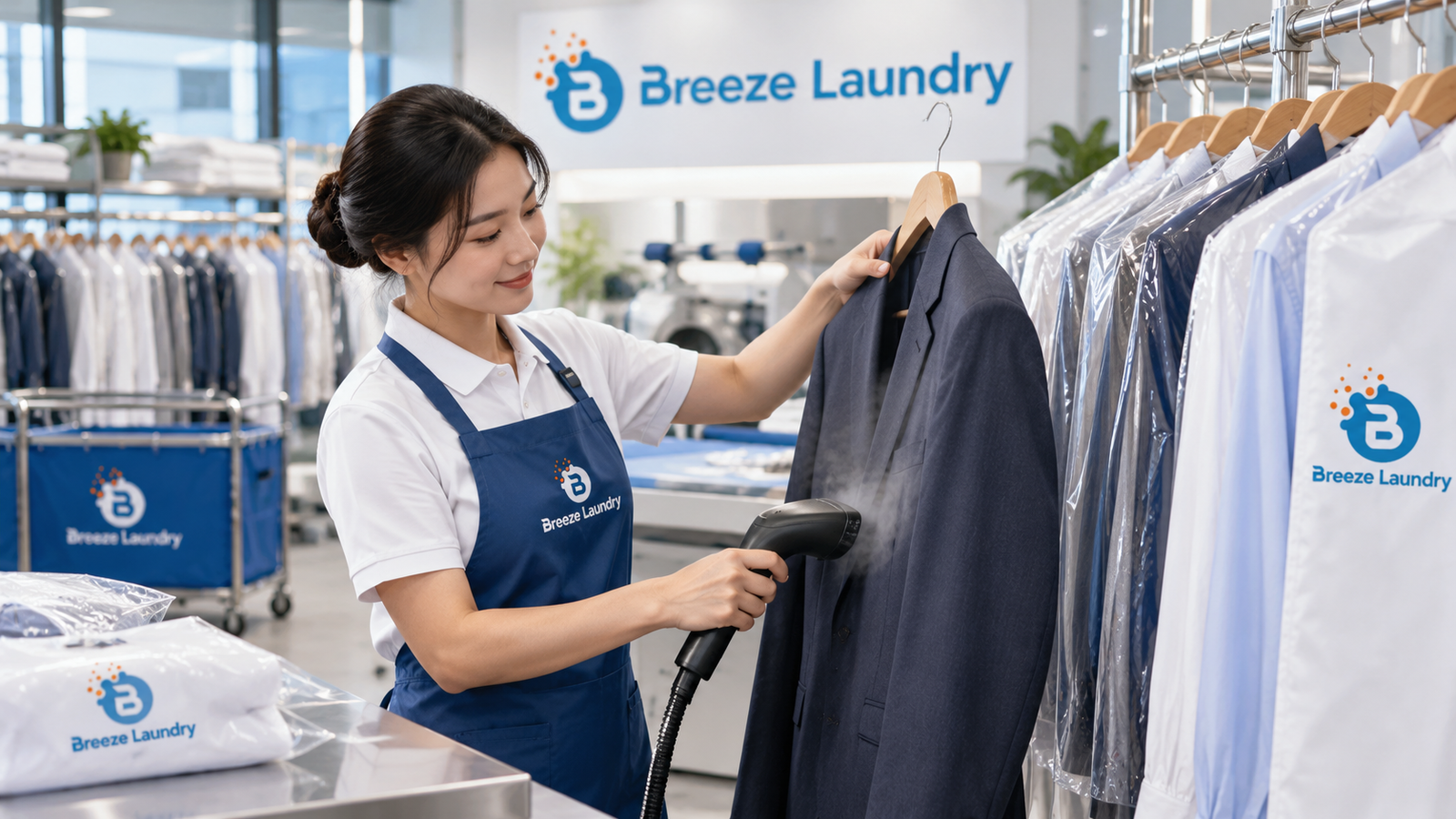
The final appearance comes from more than cleaning alone. Depending on the garment, finishing may include pressing, steaming or other shaping steps that the care instructions allow.
After finishing, garments are inspected, brought back together with the rest of the order and prepared for return. That is why professionally cleaned clothing often looks more structured and ready to wear than an item that has simply completed a machine cycle.
| Need professional garment care? Breeze Laundry offers dry cleaning for suits, dresses, specialty items and garments that require professional care. Use the live service checker for current availability and pricing. |
Does Dry Cleaning Use Any Water?
Dry cleaning does not use water as its primary cleaning medium, but saying that water never appears anywhere in the process is too absolute.
The FTC’s definition allows controlled moisture to be added to solvent and also recognizes steam pressing or steam-air finishing as part of normal dry-cleaning care. A garment’s label can specifically prohibit or modify those steps when necessary.
That distinction is important for accuracy: dry cleaning is primarily solvent-based, not necessarily a zero-moisture process from beginning to end.
What Solvent Is Used in Dry Cleaning?
There is no single solvent used by every dry cleaner.
Care labels can identify a safe solvent when a garment cannot tolerate all commercially available options. Professional cleaners may also use different solvent systems and equipment.
Perchloroethylene, often called PCE or perc, has historically been used in dry cleaning. However, the U.S. Environmental Protection Agency is now phasing out PCE use in dry cleaning over a 10-year period under its current risk-management rule.
See the EPA’s current PCE risk-management page for the latest federal regulatory context.
Breeze Laundry does not need to claim a specific solvent chemistry in this article. The relevant customer question is whether the garment can be professionally cleaned according to its care requirements.
Dry Cleaning vs Washing: What Changes?
Washing and dry cleaning both remove soil, but they use different primary cleaning media and are intended for different garment-care needs.
A standard wash uses water, detergent and agitation. Dry cleaning uses a professional solvent-based process and may include specialized stain treatment and finishing.
For the full decision guide, read Dry Cleaning vs Washing: Which Does Your Clothing Actually Need?.
What Should You Tell a Dry Cleaner Before Cleaning?
A little context can help the cleaner assess the garment more effectively.
Before handing over an item, consider pointing out:
- the location of visible stains;
- what caused the stain, if you know;
- any home treatment already applied;
- loose buttons, trim or existing damage;
- a care label that is difficult to find or read;
- any part of the garment you are especially concerned about.
Avoid aggressively treating an important garment at home just before professional cleaning. Heat, rubbing or the wrong chemical can change a stain or affect the fabric.
Can Dry Cleaning Remove Every Stain?
No cleaning method can responsibly promise complete removal of every stain.
Results depend on the substance, how long it has been present, previous treatment, fabric type, dye stability and whether the stain has already changed the material.
Professional stain assessment improves the chance of choosing an appropriate treatment, but the goal should be safe garment care rather than an unrealistic guarantee.
Dry Cleaning in Richmond and Houston
Breeze Laundry provides dry cleaning for customers in Richmond and West Houston, with pickup and delivery available in eligible service areas.
Use the Pickup & Delivery availability checker to confirm the services available for your exact address.
View the Richmond location | View the Houston / Westheimer location
The Bottom Line: Dry Cleaning Is a Process, Not Just a Machine
If you were wondering how dry cleaning works, the most useful answer is that the solvent cleaning cycle is only the center of a larger garment-care process.
Inspection, care-label interpretation, stain treatment, solvent cleaning, recovery, finishing and quality control all contribute to the final result.
The exact workflow changes with the garment, which is why professional dry cleaning should be treated as garment-specific care rather than a one-setting-fits-all service.
If your garment calls for professional care, check Breeze Laundry Dry Cleaning availability and choose the option available for your location or address.
Frequently Asked Questions
Does dry cleaning actually get clothes wet?
Yes, in the sense that liquid solvent contacts the garment. It is called dry cleaning because water is not the primary cleaning medium.
Does dry cleaning use water?
Not as the main cleaning medium. However, the FTC definition allows controlled moisture and steam finishing in a normal dry-cleaning process unless the care instructions restrict those steps.
What chemical is used in dry cleaning?
Different professional systems can use different solvents. PCE has historically been used in the industry, but EPA regulations now provide for a 10-year phaseout of PCE in dry cleaning. Do not assume every cleaner uses the same solvent.
Does dry cleaning remove all stains?
No. Stain removal depends on the stain, fabric, dye, age of the mark and previous treatment. Professional cleaners can select appropriate treatments, but no responsible service can guarantee every stain will disappear.
Can dry cleaning shrink clothes?
Dry cleaning avoids a standard water wash, but no cleaning method makes every garment immune to dimensional change or distortion. The care label, garment construction and correct processing still matter.
How long does dry cleaning take?
Turnaround varies by garment, service, location and current availability. Breeze Laundry customers should use the live service checker or relevant location page for the current options rather than relying on a generic timing estimate.
Is dry cleaning the same as Wash & Fold?
No. Wash & Fold is for everyday machine-washable laundry. Dry cleaning is a separate professional garment-care process for items whose care requirements call for it.
